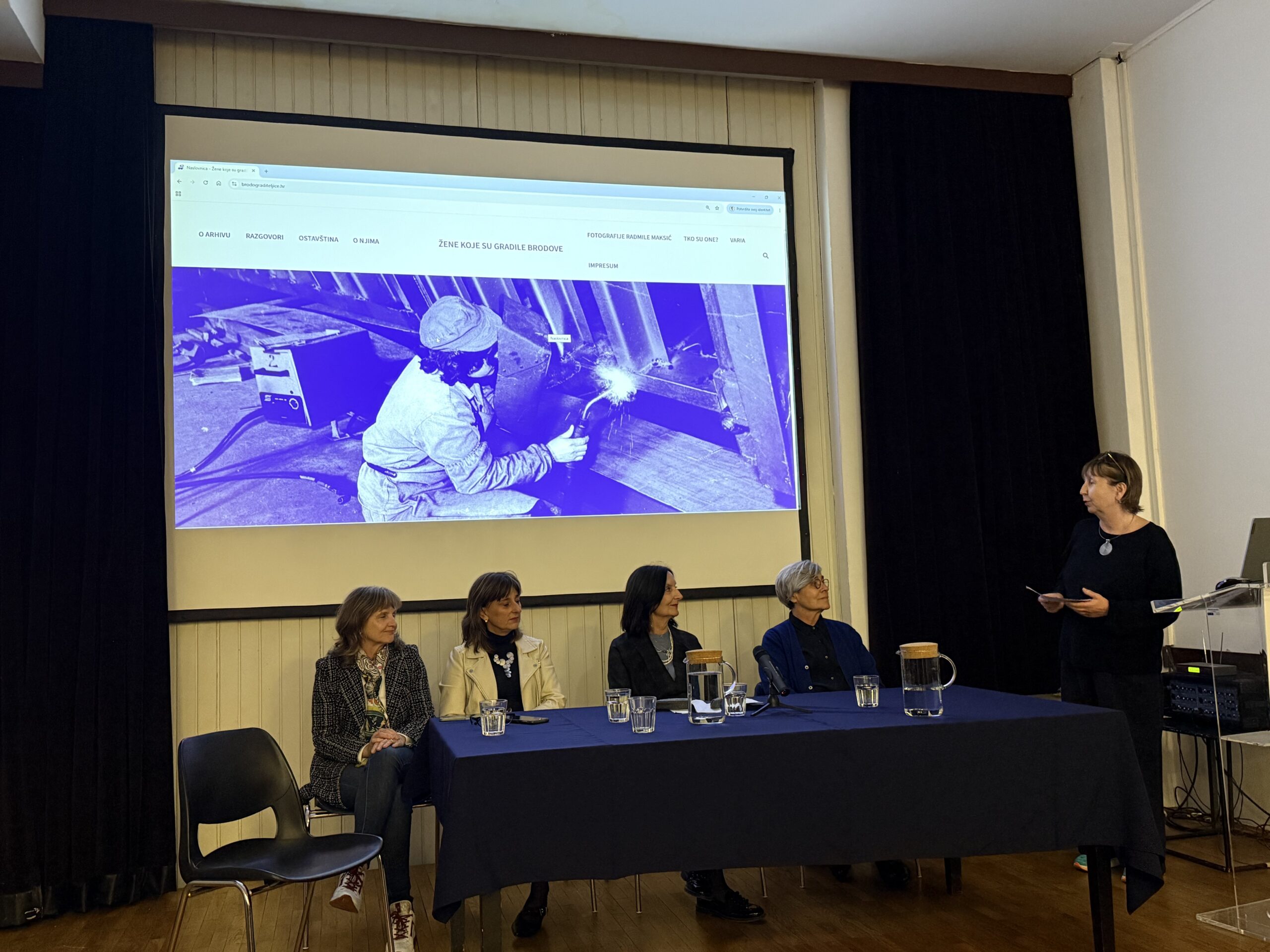
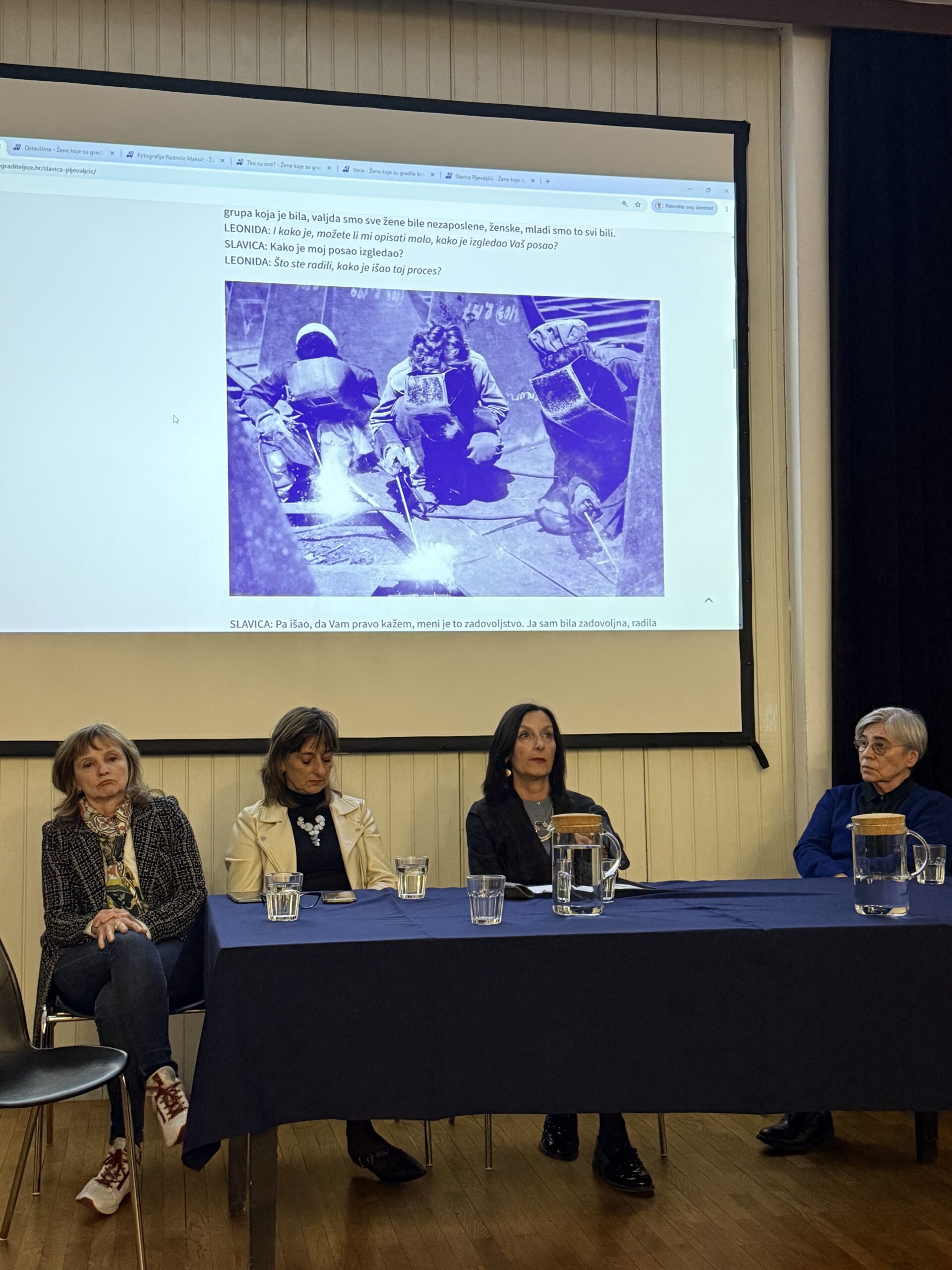
On 19 October 2026, the project Women Who Built Ships: An Online Archive in the Making was presented at the Nikola Tesla Technical Museum in Zagreb. It is an interdisciplinary cultural-anthropological study and also a participatory community project, led by Amra Pende and Leonida Kovač. It examines the social and cultural effects of industrialization in the second half of the 20th century, as well as the consequences of deindustrialization.
The presentation was attended by Vesna Skorupan Wolff, PhD and Adriana Vincenca Padovan, PhD.
Women Who Built Ships: An Online Archive in the Making is available at https://brodograditeljice.hr
The research starts from the fact that, in the modern era, the life and urban development of Pula have been inseparably tied to the founding of the Naval Arsenal of the Austro-Hungarian Navy (1856) and, later, in the second half of the 20th century, to industrial production at the Uljanik shipyard. After the Second World War, a modern shipyard was built in which a highly skilled workforce developed inventive production technologies, and Uljanik became one of the most respected and competitive shipyards in the world. In the last decades of the 20th century, it employed between 8,000 and 10,000 workers. At the turn of the 21st century, a shift in the political and economic paradigm, namely systematic deindustrialization and an imperative move from complex industrial production to a tourism monoculture, set off processes of transformation with devastating sociocultural implications. These led to Uljanik’s bankruptcy in 2019, and today it employs around three hundred people.
According to the data researched so far, from 1954 to 2024 alone, Uljanik employed 1,667 women in 397 occupations and at various levels of qualification, from unskilled workers who did the most physically demanding jobs to highly qualified and narrowly specialized experts of international renown.
The aim of this project and of the research by authors Amra Pende and Leonida Kovač is primarily to bring out of invisibility and anonymity the many human lives woven into the creative work processes that produced not only one of the most significant European shipyards, but also a modern city that would not exist without shipbuilding. In the initial phase of the research and of building the archive, the authors’ work focused primarily on the personal histories of former and current Uljanik employees, and on collecting written and visual materials from their personal archives and from the shipyard’s archives.
The backbone of Women Who Built Ships: An Online Archive in the Making consists of audio recordings of conversations with former and current Uljanik workers, published on the website under the theme “Conversations” (“Razgovori”). The section “Legacy” (“Ostavština”) offers a series of published articles, documents, and records from Uljanik’s history related to the employment-law status of women, their position, the jobs they performed, descriptions of business processes at Uljanik, the lives of Uljanik’s women workers, and similar topics. The section “About Them” (“O njima”) includes information about deceased women employed at Uljanik. Short accounts of their lives were written by family members, such as grandchildren, children, and spouses, or by friends and colleagues from Uljanik, or the information was taken from previously published articles. Of particular interest is the section “Photographs by Radmila Maksić,” which contains a series of authentic photographs taken between the early 1950s and 1984, showing completed ships, ships under construction, launchings, ship engines, and scenes from Uljanik’s production plants. “Who Are They” (“Tko su one”) is a section featuring reproductions of photographs and postcards from the collections of the Historical and Maritime Museum of Istria. “Varia” is the last theme on the Online Archive’s website and contains a collection of various documents and records about Uljanik.
The research by authors Amra Pende and Leonida Kovač, devoted to the activities of women of different professions, education levels, and social backgrounds, and to the importance of their work in the shipbuilding industry that until recently underpinned Pula’s strong economic and social development, is of manifold significance for the history of the city of Pula and for the history of Croatian shipbuilding and maritime affairs. Numerous memories, biographies, historical records, materials, and pieces of information remain recorded and documented, and they can serve for further, comprehensive research on this topic as well as on many related ones.